Medical Tubing Extrusion Explained: Materials, Tolerances and What Actually Matters
A plain-language look at how medical tubing is extruded — the polymers used, why tolerances are measured in microns, and the process controls that separate medical work from ordinary tubing.
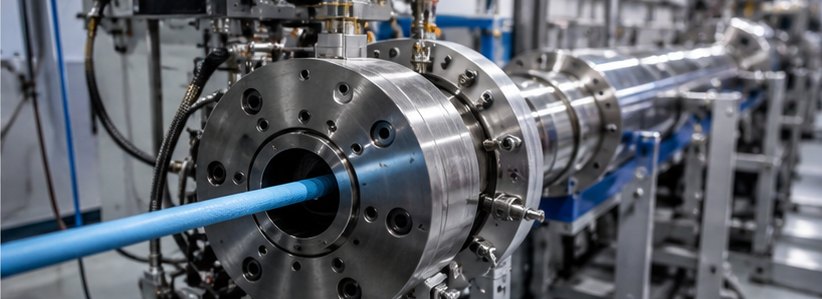
Medical tubing looks deceptively simple. It is, after all, a hollow polymer profile — the same basic idea as a drinking straw or a garden hose. But the moment tubing has to carry a drug, guide a catheter through an artery or feed a peristaltic pump, the tolerances and material demands jump to a level that ordinary extrusion never touches.
This article walks through what actually happens when medical tubing is extruded, and why the discipline is so unforgiving.
The polymers do most of the work
The material dictates almost everything downstream — biocompatibility, flexibility, how the tube behaves at body temperature, and how easily it can be bonded or tipped later. A handful of families dominate:
- Thermoplastic polyurethane (TPU) — tough, flexible and kink-resistant, the default for many catheters.
- Nylon (polyamide) — high strength and pressure resistance, common in balloon catheters.
- PEBA (Pebax) — prized for the ability to blend hardness grades to tune stiffness along a shaft.
- Silicone — biostable and soft, used where long dwell time in the body is expected.
- PVC — still widespread in disposables such as IV and drainage lines, where cost matters.
Each polymer has its own melt window, shear sensitivity and drying requirement. Nylon and TPU in particular are hygroscopic: extrude them without proper drying and you get bubbles, splay and inconsistent walls.
Why tolerances are measured in microns
Consumer tubing is happy with tolerances of a few tenths of a millimetre. Medical tubing routinely holds inner and outer diameters to ±0.02 mm or tighter. There are real clinical reasons:
- Fit and function. A guidewire has to slide through a catheter lumen with a specific clearance — too tight and it binds, too loose and the physician loses control.
- Flow rate. For drug-delivery and infusion lines, lumen area sets dose accuracy. Small diameter drifts change flow non-linearly.
- Bond integrity. Downstream tipping, flaring and over-moulding all assume a known wall thickness.
Holding those numbers is a closed-loop problem: a laser micrometer measures the tube as it leaves the die, and the line adjusts haul-off speed, vacuum and melt pressure to keep it on target. The quality of the medical tubing extrusion lines themselves — screw design, melt stability, take-off precision — is what makes those micron tolerances repeatable across a full production run rather than just achievable on a good day.
The line, end to end
A medical tubing line is a chain of tightly coordinated stages:
- Drying and feeding. Resin is dried to spec and fed to the extruder.
- The extruder. A precision single screw melts and pumps the polymer at a stable pressure and temperature. Melt stability here is everything — a pressure ripple becomes a diameter ripple.
- The die and tip. Molten polymer flows around a mandrel to form the lumen. Tip and die geometry, plus draw-down, set the final dimensions.
- Vacuum sizing and cooling. The tube is drawn into a vacuum trough where it is sized and quenched. Vacuum level trims the outer diameter in real time.
- Laser measurement. Non-contact gauges read OD (and sometimes wall) continuously.
- Haul-off and cutting. A precision belt puller sets line speed — the other main diameter lever — before the tube is cut or spooled.
What separates medical from ordinary extrusion
Three things, mostly:
- Process control and data. Every meaningful variable is logged. When a device is implanted or infused, traceability is not optional.
- Cleanliness. Much of this work happens in controlled or cleanroom environments to keep particulates out of the product.
- Validation. A medical line is not just set up; it is qualified (IQ/OQ/PQ) and the process is proven capable before a single sellable metre is made.
Takeaways
Medical tubing extrusion is a precision-engineering discipline dressed up as a simple polymer process. The polymer choice sets the envelope; the tolerances make it hard; and the process control, cleanliness and validation are what make it medical. Anyone specifying tubing or a line should start with the material and the tolerance budget — everything else follows from those two decisions.