Quality Control and Cleanroom Practice in Medical Tubing Production
How medical tubing manufacturers prove a tube meets spec — in-line measurement, cleanroom classes, validation and traceability — and why these systems matter as much as the extrusion itself.
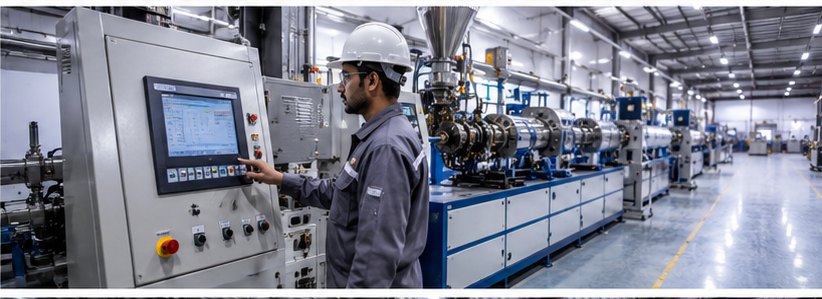
You can extrude a perfect tube and still fail, because in medical manufacturing the product is only half the deliverable. The other half is proof — evidence that every metre met specification, was made under controlled conditions, and can be traced back to its raw material and process settings. This is the part of medical tubing that outsiders rarely see and insiders spend most of their time on.
In-line measurement: catching defects as they happen
Because tubing is produced continuously, quality control has to be continuous too. The workhorses are non-contact:
- Laser micrometers read outer diameter (and increasingly wall thickness) hundreds of times per second as the tube leaves the sizing trough.
- Ultrasonic wall gauges measure wall thickness and concentricity without touching the product.
- Vision systems watch for surface defects, gels and specks.
Crucially, these are not just alarms. Their signals feed the line’s closed-loop control, nudging haul-off, vacuum and output to keep dimensions centred. A well-tuned line spends its run correcting tiny drifts before they ever become scrap.
Cleanroom classes and why they apply
Particulates are a contamination risk in any device that enters the body. Much medical tubing is therefore extruded, or at least handled and packaged, in classified cleanrooms — commonly ISO Class 7 or 8 (equivalent to the older Class 10,000 / 100,000). The practical implications:
- Filtered air and controlled pressure keep particulates off the product.
- Personnel gown up and follow strict entry procedures.
- Materials and equipment are selected and maintained to avoid shedding.
The extrusion hardware itself is specified for these environments — stainless surfaces, contained lubrication and designs that are straightforward to clean.
Validation: proving the process, not just the part
A medical process is not merely set up; it is qualified. The standard framework is:
- IQ (Installation Qualification) — the equipment is installed and documented correctly.
- OQ (Operational Qualification) — the process performs across its intended operating range.
- PQ (Performance Qualification) — the process reliably makes conforming product under real production conditions.
Once qualified, the recipe is locked. Changing a screw temperature or haul-off profile is a controlled event, not an operator’s discretion. This is why the stability and repeatability of the underlying equipment matters so much: a line from an established extruder machine manufacturer with predictable, well-documented behaviour is far easier to validate and keep in a validated state than an ad-hoc one.
Traceability: the paper (and data) trail
If a device is ever investigated, the manufacturer must be able to answer: which resin lot, which line, which settings, which operator, which shift? That means:
- Raw material lots logged and linked to production runs.
- Process data captured and retained.
- Finished product batches tied back to all of the above.
Modern lines make this easier by logging their own parameters automatically, but the discipline is organisational as much as technical.
Why this half matters as much as the extrusion
It is tempting to treat quality systems as bureaucracy bolted onto the “real” work of making tube. In medical manufacturing that gets the priority backwards. The measurement, cleanroom discipline, validation and traceability are what let a tube be used in a human body at all. A beautifully extruded tube with no evidence behind it is, from a regulatory standpoint, worthless.
The lesson for anyone entering medical tubing: budget as much attention for how you will prove quality as for how you will produce it. The two succeed or fail together.